
If you have ever stared at a directory of eye care providers and had no idea which one to call, you are in good company. Optician, optometrist, and ophthalmologist are three words that sound similar, get used interchangeably by most people, and actually refer to three completely different professions with different training, different scopes of practice, and different roles in your eye care.
Understanding the difference will save you time, help you get the right care from the right provider, and give you a much clearer picture of what is actually happening when you walk into a place like The Eye Bar in Murfreesboro.
Ophthalmologist
Starting at the top of the medical hierarchy, an ophthalmologist is a medical doctor who specializes in eye and vision care. Becoming an ophthalmologist requires a full medical degree followed by a residency program specifically focused on the eyes, and often additional fellowship training in a subspecialty.
Ophthalmologists are the only eye care providers qualified to perform eye surgery. Cataract surgery, LASIK, glaucoma procedures, retinal surgery — these all fall within the scope of an ophthalmologist. They can also diagnose and treat eye diseases, prescribe medications, and perform comprehensive eye exams.
If you have a serious eye condition, a disease affecting your vision, or you are considering a surgical procedure, an ophthalmologist is who you need. For routine vision care and eyewear, they are typically not the first stop, and in many cases they will refer you elsewhere for the fitting side of things.
Optometrist
An optometrist holds a Doctor of Optometry degree, which requires four years of optometry school following an undergraduate degree. Optometrists are not medical doctors but they are licensed to examine eyes, diagnose certain eye conditions, prescribe corrective lenses, and in most states prescribe medications for some eye conditions.
When most people think about getting their eyes checked, they are thinking about going to an optometrist. A comprehensive eye exam with an optometrist covers visual acuity, eye health screening, and if needed, a prescription for corrective lenses. Optometrists also screen for conditions like glaucoma, macular degeneration, and diabetic eye disease, and refer patients to an ophthalmologist when something falls outside their scope.
If you need an eye exam or a new prescription, an optometrist is typically where you start. What they do not do is make your glasses. That is where the optician comes in.
Optician
An optician is a trained professional who specializes in fitting, adjusting, and fabricating eyewear based on a prescription written by an optometrist or ophthalmologist. Opticians do not examine eyes or write prescriptions. What they do is take that prescription and turn it into a pair of glasses that actually works correctly on your face.
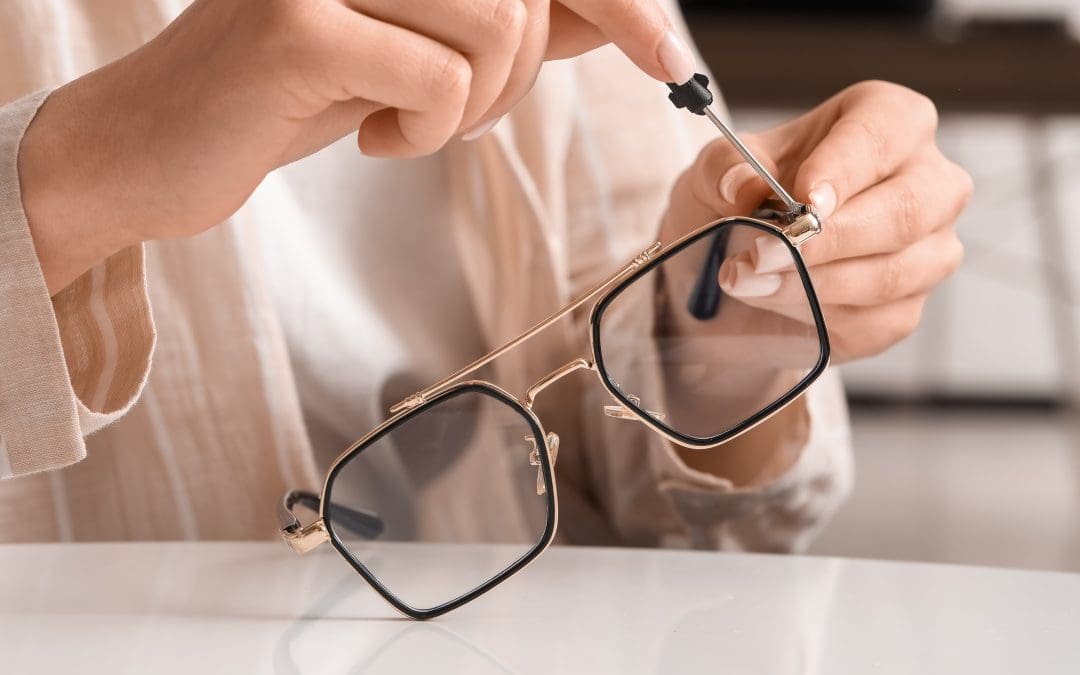
This involves far more skill than most people realize. An optician reads and interprets prescriptions, selects appropriate lens materials and designs, takes precise measurements including pupillary distance and fitting height, cuts and mounts lenses into frames, and adjusts the finished glasses to sit correctly on each individual patient. Getting any of these steps wrong affects how clearly you see and how comfortable your glasses feel.
In Tennessee, becoming a licensed optician is a four step process that requires a serious commitment to the craft. First, you either complete a two year degree from an optical college or serve a three year apprenticeship under a licensed optician, which is exactly the path Jeremey took, learning the trade hands-on from the ground up. From there, you have to pass the American Board of Opticianry national board exam, which covers ophthalmic optics and dispensing. Then comes the National Contact Lens Exam, a separate certification focused specifically on contact lens fitting. Finally, you have to pass the Tennessee state board exam before you can practice as a licensed optician in this state. Four steps, years of preparation, and a credential that reflects genuine technical expertise. It is not something you pick up in a weekend training course.
Jeremey Morris at The Eye Bar in Murfreesboro is a licensed optician with nearly 30 years of personal experience in the field. When you bring your prescription to The Eye Bar, you are working with someone who has spent the better part of three decades doing this work at a high level. That depth of experience is not something you encounter at a chain optical store, where the person helping you may have had a few weeks of on-the-job training.
How the Three Work Together
In a well-coordinated eye care experience, these three providers serve distinct and complementary roles.
Your optometrist examines your eyes and writes your prescription. If there is a medical concern, they refer you to an ophthalmologist. Once you have your prescription in hand, you bring it to a licensed optician who fits you for the right lenses and frames for your vision needs, your face, and your lifestyle.
The optician is the last step in the process and in many ways the most hands-on. A prescription from the best optometrist in the world still has to be correctly interpreted, accurately measured, and properly fitted to actually work the way it is supposed to. This is what Jeremey does every single day at The Eye Bar.
Why This Matters When You Are Buying Glasses
Most chain optical stores blur the line between these roles in ways that do not always serve the customer. You may be helped by someone with limited formal training who is working from a script rather than from genuine optical expertise. The difference between that experience and working with a licensed optician who has nearly 30 years behind him is significant, and most people feel it immediately.
At The Eye Bar in Murfreesboro, every fitting starts with Jeremey. He reads your prescription, asks about your lifestyle, takes precise measurements, and helps you understand what your lenses actually need to do. Then he helps you find a frame that fits correctly and looks the way it should on your face. It is a complete process, done properly, every time.
Come See a Licensed Optician in Murfreesboro
If you have a current prescription and you are ready to get it into a pair of glasses that actually fits, The Eye Bar is the place to go. No chain store process, no undertrained staff, just nearly 30 years of licensed optician expertise working for you.
711 N Thompson Ln F, Suite F, Murfreesboro, TN 37129
Monday through Friday 9am to 5pm, Saturday 9am to 1pm