You just had your eyes examined and the doctor handed you a slip of paper covered in abbreviations, plus and minus signs, and numbers that mean absolutely nothing to you. You are not alone. Eyeglass prescriptions are one of those documents that almost everyone receives and almost no one fully understands.
Knowing how to read your prescription will not make you an optician, but it will help you have a more informed conversation when you come in for a fitting, understand what your vision correction actually involves, and feel more confident about the glasses you are buying. Here is a plain language breakdown of what you are actually looking at.
The Basic Layout
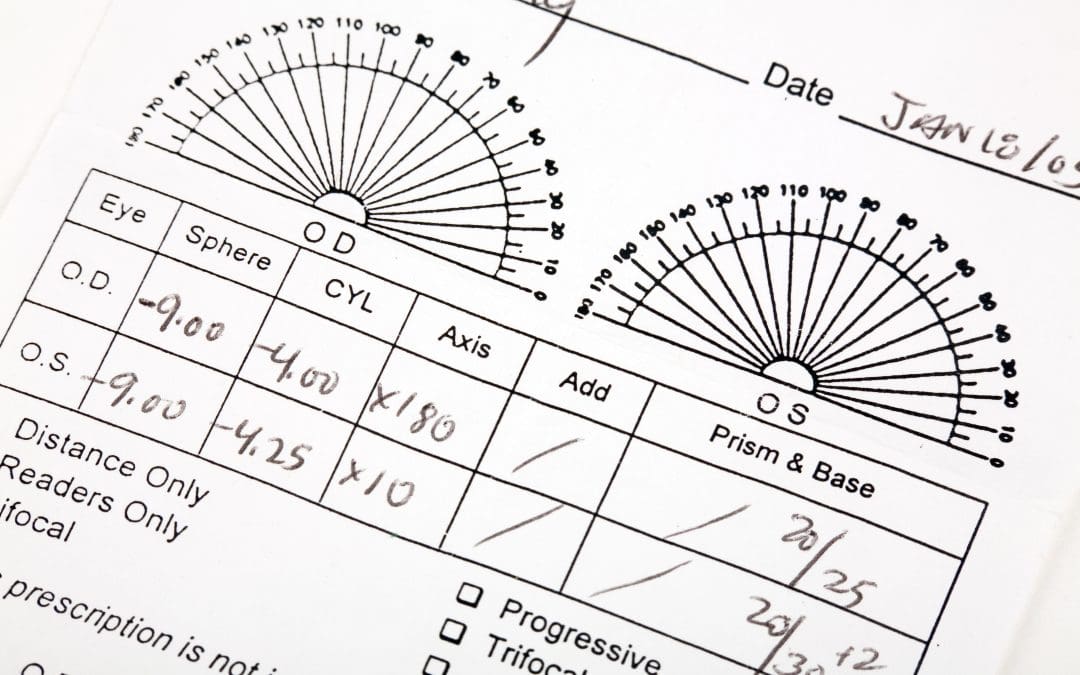
Most eyeglass prescriptions are organized into two rows — one for your right eye and one for your left. You will typically see them labeled OD and OS, which are abbreviations from the Latin terms oculus dexter and oculus sinister, meaning right eye and left eye respectively. Some prescriptions also include a third line labeled OU, which refers to both eyes together.
Within those rows you will find a series of columns, each representing a different measurement of how your eyes focus light. The most common columns are Sphere, Cylinder, Axis, and Add. Here is what each one means.
Sphere
The Sphere value, sometimes abbreviated as SPH, is the one most people are vaguely familiar with. It tells you the basic power of the lens needed to correct your vision and is measured in units called diopters.
A negative Sphere number means you are nearsighted, meaning you see clearly up close but struggle at a distance. A positive Sphere number means you are farsighted, meaning distance vision may be clearer but close up tasks like reading can be difficult. The larger the number in either direction, the stronger the correction needed.
If your prescription says Sphere -2.50 for your right eye, that means you are moderately nearsighted in that eye and need a lens with that level of correction to see clearly at a distance.
Cylinder and Axis
These two values go hand in hand and both relate to astigmatism. Astigmatism is an extremely common condition where the cornea or lens of the eye is not perfectly round, causing light to focus unevenly and resulting in blurred or distorted vision at various distances.
The Cylinder value tells you how much astigmatism correction you need, again measured in diopters. Like the Sphere, it can be positive or negative depending on the method your eye doctor uses. If your prescription has no Cylinder value, or if it says SPH or DS in that column, it means you do not have significant astigmatism.
The Axis value tells your optician the orientation of the astigmatism correction on the lens. It is measured in degrees from 1 to 180 and has no plus or minus sign. The Cylinder value alone is not enough information — the lens has to be cut and positioned at exactly the right angle, which is what the Axis specifies. This is one of the reasons why professional fitting matters. Getting the Axis even slightly wrong affects how clearly you see.
Add
The Add value, short for Addition, appears on prescriptions for people who need bifocal or progressive lenses. It represents additional magnifying power added to the bottom portion of the lens to help with close up vision, most commonly for reading.
Add values are always positive and typically range from +0.75 to +3.00. If you are over 40 and finding it harder to read menus, your phone, or anything up close, there is a good chance your prescription includes an Add value. Progressive lenses, which blend distance and reading correction seamlessly without a visible line, are one of the most popular solutions for this and something Jeremey fits regularly at The Eye Bar.
Pupillary Distance
You may also see a measurement called PD, or Pupillary Distance, on your prescription or on a separate document from your eye doctor. This is the distance in millimeters between the centers of your pupils and it is a critical measurement for making sure the optical center of each lens lines up correctly with your eyes.
An incorrect PD measurement is one of the most common reasons online glasses fail to feel right even when the prescription numbers are accurate. When you get fitted at The Eye Bar, Jeremey takes this measurement precisely and uses it to ensure your lenses are positioned exactly where they need to be.
The Numbers Only Tell Part of the Story
The numbers on your prescription only tell part of the story. Your prescription tells your optician what correction your eyes need, but it does not say anything about the best lens material, coating, or design for your lifestyle. Those decisions require a conversation.
Do you spend long hours in front of screens? There are lens options that address digital eye strain. Do you drive at night? Anti-reflective coatings make a significant difference. Do you spend time outdoors? Polarized lenses or photochromic lenses that darken in sunlight might be the right call. Are you active? Lens material matters for both durability and safety.
This is exactly the kind of conversation that happens at The Eye Bar in Murfreesboro and does not happen at a chain store or an online retailer. Jeremey has nearly 30 years of personal experience as a licensed optician, and he uses that experience to help every customer understand not just what their prescription says, but what it means for how their glasses should be made.
Bring Your Prescription In
If you have a current prescription and you are ready to put it into a pair of frames you will actually love wearing, The Eye Bar is the place to start. Bring it in, ask every question you have, and let Jeremey help you understand exactly what you are working with.
711 N Thompson Ln F, Suite F, Murfreesboro, TN 37129
Monday through Friday 9am to 5pm, Saturday 9am to 1pm